

What do Aston Martin, Fashion TV, Tonino Lamborghini Casa and Filmfare have in common with the slums of Mumbai, one of Dubai's largest building materials companies and Danube Group, a diversified conglomerate with a turnover of $2 billion last year? Just one person: Rizwan Sajan.
The first-generation entrepreneur was born in the slums of Ghatkopar in Mumbai. After dropping out of school, he became a salesman in Kuwait, founded a trading firm in Dubai in 1993, bought the Middle East rights to Filmfare magazine, and now builds luxury apartments and villas whose interiors are designed through tie-ups with brands such as Aston Martin, Fashion TV and Tonino Lamborghini Casa.
The 1% Man
If you haven't noticed Danube Group, you probably haven't been watching the cricket World Cup, where the Dubai-based conglomerate with interests in building materials, home décor and real estate has been advertising heavily, or flying with major Indian airlines, where "The 1% Man" stickers appear on the backs of seat headrests. In recent months, Sajan and Danube Group have been actively encouraging Indians to buy high-end and luxury homes in Dubai, pitching it as a great investment destination.
How does one explain the journey from the slums to luxury towers? Sajan begins with gratitude. "God has been kind," smiles Sajan, who entered the Middle East property market in 2014 and has rolled out 25 residential projects in the UAE in nine years, including 10 in the last 19 months, while making luxury affordable with a 1 percent per month payment plan. Asked how much of his success is luck and how much hard work, he says: "I would give them equal chances."
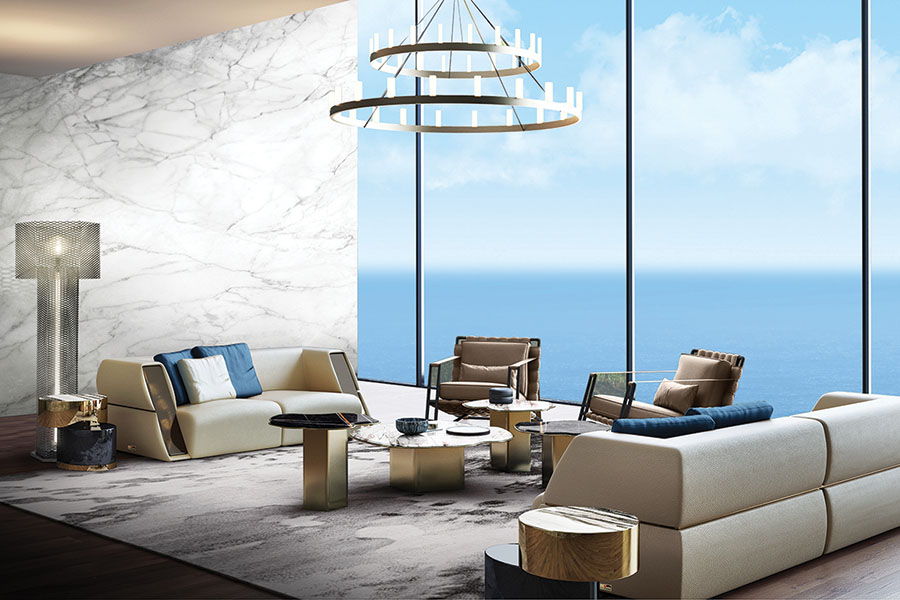
Sajan builds luxury apartments and villas with interiors by brands such as Tonino Lamborghini Casa.
However hard you work, he stresses, you will fail if luck is not on your side. "Similarly, even if you're lucky but you don't work hard, you are bound to fail," he adds. Being the right person at the right time and place goes a long way to explaining the rise of a man who had a rough childhood.
Early Days in Mumbai
There were signs of luck even in his hardest years, though the young Sajan could not see them at the time. His father won a "subsidised" lottery, moved the family into a tiny apartment and did his best to provide for them, but his earnings were never enough. Sajan and his sisters walked several kilometres to school, and their combined pocket money of ₹15 barely bought anything at the canteen. So he decided to earn some money himself, persuading his father to lend him ₹1,000 to start trading.
His first customers were his schoolmates. He bought books in bulk and sold them at market price, making some extra money. "Now I could buy food from the canteen," he recalls. He went on to sell milk in the neighbourhood and made the most of the festival calendar, from sourcing rakhis to selling firecrackers.
Tragedy struck when he was 16. His father died, and Sajan left school to support the family. With the small savings his father had built up at his workplace, he started manufacturing box files.
The Kuwait Years
The business worked, but making ends meet was still hard. Two years later, his uncle offered him a job in Kuwait. "That was my lottery," Sajan recounts. In Mumbai he had been earning ₹6,000; his new job paid ₹18,000 (150 dinar) a month. Starting as a trainee salesman, he quickly became a manager. "My salary increased from 150 dinar to 1,500 dinar," he says, and with sales commission the source puts at around 50,000 dinars a month, his earnings soared. "That was a lot of money for me," he adds. He bought a Toyota Land Cruiser and a house in Bandra, and paid for his sister's wedding.
Then, in August 1990, Saddam Hussein invaded Kuwait. Sajan's world came crashing down and he had to return to Mumbai. "That was the second turning point in my life," he says. "I was back to zero."
Building Danube
A few years later, he tried his luck in Dubai. In 1993, he started a trading firm. "It was a brokerage business, where I was making commission," he says, and soon he moved into building materials. Over the next decade and a half he kept diversifying: the sanitary brand Milano in 2006, home furnishings in 2008, and Alucopanel, an aluminium composite panel business, in 2012. Real estate followed in 2014. "Since then there has been no looking back," says Sajan.
The Turning Point: The 1 Percent Plan
What changed his real estate business and his fortunes? "It was the 1 percent plan," he says. After a small down payment, buyers paid a monthly payment of 1 percent, with the balance due once the building was ready. "We realised that 80 to 90 percent of expats were still renting, and I wanted to convert them into buying their own properties," he says. By the time a building was ready, buyers had already paid 50–60% of the price, so banks saw no risk in lending. "Now I am democratising luxury," he says, beaming.
Why Dubai, Not India
Asked whether he plans to enter the Indian property market, he recounts bitter experiences. His first apartment, on the fourth floor of a building in Mumbai, ran into trouble because the builder lacked permission for the fifth and sixth floors. "Twelve years ago, I bought an apartment in Parel. Last month I got possession," he says.
Dubai, he stresses, offers a far bigger opportunity in real estate than most countries. "People are making Dubai their second home because of the trust and confidence they have in the city," he says. Apart from a small furnishing business in India, which he says runs on autopilot, Sajan is focused on expanding in the Middle East with a missionary zeal to democratise luxury.
Source: Forbes India


